
| Date: | Saturday 12 April 2025 |
| Time: | 12:03 |
| Type: | 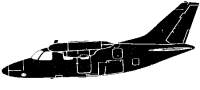 Mitsubishi MU-2B-40 Solitaire |
| Owner/operator: | Dynamic Spine Solutions LLC |
| Registration: | N635TA |
| MSN: | 458SA |
| Year of manufacture: | 1985 |
| Fatalities: | Fatalities: 6 / Occupants: 6 |
| Other fatalities: | 0 |
| Aircraft damage: | Destroyed |
| Category: | Accident |
| Location: | near Copake, NY -  United States of America United States of America |
| Phase: | Approach |
| Nature: | Private |
| Departure airport: | White Plains-Westchester County Airport, NY (HPN/KHPN) |
| Destination airport: | Columbia County Airport, NY (1B1) |
| Investigating agency: | NTSB |
| Confidence Rating: |  Information verified through data from accident investigation authorities Information verified through data from accident investigation authorities |
Narrative:
On April 12, 2025, about 1203 eastern daylight time, a Mitsubishi MU-2B-40, N635TA, was destroyed when it was involved in an accident near Copake, New York. The pilot and five passengers were fatally injured. The airplane was operated as a Title 14 Code of Federal Regulations Part 91 personal flight.
A review of preliminary ADS-B data and archived voice communication information provided by the Federal Aviation Administration (FAA) showed that the airplane departed Westchester County Airport (HPN), White Plains, New York, about 1134, and flew on a northeast to northern track towards their planned destination of Columbia County Airport (1B1), Hudson, New York. The data showed that the airplane reached a maximum cruise altitude of about 16,000 ft mean sea level (msl).
At 1148:48, the Boston Air Route Traffic Control Center (ARTCC) controller cleared the pilot to descend to 6,000 ft msl. The pilot acknowledged and advised the controller that he had the weather for 1B1 and requested the RNAV (GPS) approach to runway 3. The controller advised the pilot to cross PUCBY (initial approach fix), at or above 4,000 ft msl and cleared him for the approach. At 1157:52, the pilot advised the controller that he was on a missed approach and when queried by the controller about his intentions, he responded that he would take vectors for another approach. The controller instructed the pilot to climb and maintain 4,000 ft msl. At 1159:08, the pilot was instructed by the controller to turn right to a heading of 100°. About 1 minute later, the controller instructed the pilot to continue the right turn to a heading of 140° and expect direct PUCBY in about five miles, to which the pilot acknowledged. At 1202:40, the controller instructed the pilot to cross PUCBY at 4,000 ft msl and cleared him for the RNAV (GPS) Runway 3 approach at 1B1, which the pilot acknowledged.
About 1 minute later, the controller advised the pilot of a low altitude alert, and to check his altitude immediately, with no response from the pilot. Despite the controller’s multiple attempts, no further radio transmissions were received from the pilot. About 1203:55, the controller advised the pilot that radar contact was lost.
ADS-B data showed the airplane was about 2,450 ft msl and a groundspeed of about 107 knots when the missed approach was initiated. The airplane continued on a northerly heading for several seconds while the groundspeed had decreased to about 91 knots. The data then showed that the airplane began a right climbing turn, and throughout the turn, the groundspeed increased, to a maximum of about 144 knots. The airplane leveled off at an altitude of about 3,800 ft msl and a groundspeed of about 139 knots. Throughout the following 2 1/2 minutes, the airplane maintained an altitude between about 3,800 ft and 3,975 ft msl with a groundspeed fluctuating between about 139-189 knots.
At 1202:22, the airplane began a right turn to the southwest. About 34 seconds later, the airplane began a descent. The last data point showed the airplane at 2,150 ft msl, with a groundspeed of 118 knots.
Recorded security camera video showed there was a low overcast cloud layer present at the time of the accident. The airplane was observed in the video descending from the cloud layer in a steep descent until it impacted terrain. The sound of the engines could be heard throughout the recording.
The National Weather Service did not have any significant meteorological advisories (SIGMETs) or convective SIGMETS or center weather advisories (CWA) current over the region surrounding the accident site. The National Weather Service did have several AIRMETs current for IFR and mountain obscuration conditions, low-level wind shear (LLWS) and occasional moderate icing conditions from about 1,500 ft to 17,000 ft msl over the region.
Examination of the accident site revealed that the airplane impacted snow covered terrain on a magnetic heading of about 290° in a nose down attitude about 500 ft north from the last ADSB target. Fragments of the airplane were scattered throughout a radius of about 150 ft surrounding the main wreckage. All major components of the airplane were contained within the wreckage debris area. The fuselage was mostly fragmented and separated into multiple sections. The vertical stabilizer, rudder, horizontal stabilizers and elevators, were partially attached to the empennage. The empennage remained partially attached to the fuselage. Both wings were attached to the fuselage and were buckled throughout their span.